The post production editing stage, is also known as film editing. It is the process of making a movie image text, by the selection and ordering of a range of shot into a continuous sequence to make the movie, TV show or any other type of moving picture.
Editing can bring in sound effects, dialogue, titles and still images. Editing can help to enforce a theme, narrative or atmosphere due to the pace and combination of elements selected. This can be done by using montage, continuity editing, timing of music combined with the footage to create a mixture of emotive responses in the audience. (happy to sad).
If editing is done well, you normally would not realise it has been edited at all. Editing has been called the 'invisible art'.
Editing can include:
visual mock-ups
Sound effects by a foley artist
musical score
range of footage
credits/titles
Its effect can be to:
Create a montage - A short selection of footage compressed to illustrated time passing or to represent different narratives happening simultaneously.
-Illustrating the pace and timing of an event - speeding things up or slow them down
-Exaggerate the emotion of an actors performance
-illustrating the pace and timing of an event to speeds things up or to slow them down
-To help the director highlight messages and values to the audience they may not have seen
-Act as another point of view
-To help contrast scenes of different subject matter/locations
Just experiment with the medium as an art form
Understanding the 180 degree rule!
Two subjects in the same scene should always be shot within the same axis of 180 degrees.
This gives the illusion that the two characters that are in the scene (if this is what is happening) are either travelling towards or away from each other as they are heading in different directions.
Different areas of sound theory-
Sound:
Rhythm - A strong regular repeated pattern of movement or sound
Fidelity - A closed match between perceived sound and it supposed again e.g. cat barking = not highly fidelity)
Parallel - The sound goes with the images on the screen
Contrapuntal - Choice of music doesn't match what is being seen on the screen E.g. using a nursery rhyme for dramatic affect
Time sync +A sync - The speech or music is in time with the scene and the actors and async is the opposite
Diegetic sound - Sound whose source is visible on the screen. Everything you would genuinely heard in a scene e.g. teacher talking in a classroom
Non diegetic sound- Sound effects, music or narration which is added afterwards e.g. soundtracks
volume - Quantity or power of sound, the degree of loudness
Mise-en scene-
This refers to all the things that are 'put in the scene', as well as the way that we are shown them or, put more technically, it means the arrangement of visual weights and movement within a given space.
In movies, it is defined by the edge of the picture - the frame that encloses the images
Cinematic Mise-en-scene encompasses both the staging of the action and the way its photographed
- Set design
- Costume
- Props
- Composition
- Lighting
- And the general visual environment, as well as camera placement and movement, placement of actors and what they say and do.
In fact, everything that takes place on the set prior to the editing process.
Framing -
Refers to the relationship of the objects in the shot to the frame
Tight framing -
Is usually used for close shots
the composition is so carefully balanced and harmonised that the people photographed have little or no freedom of movement.
Loose framing -
Usually in long shots
The composition id looser and freer within the confines of the frames so that the people photographed have considerable freedom of movement.

The rule of thirds -
Divides the frame into thirds both horizontally and vertically.
For centuries, artists have followed this rule of composition, and photographers and cinematographers have follow suit.
The points where the vertical and horizontal lines cross are nice to look at and pleasing spots to place subjects or to have prospective lines converge.
Film Still -
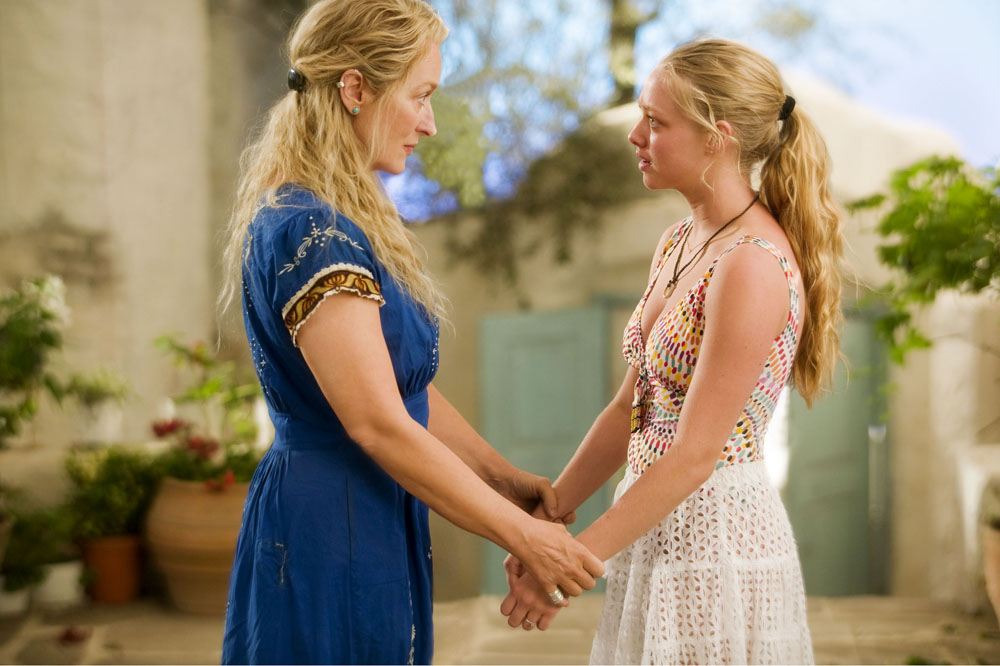
Set design-
Is in a farm/hotel which is where the film is set. The bright green plants show that it may be a good season for plants to grow. The focus is mainly on the two characters and the set is quite blurred out. The main focus in the background is the green plants and the big green doors.
Is in a farm/hotel which is where the film is set. The bright green plants show that it may be a good season for plants to grow. The focus is mainly on the two characters and the set is quite blurred out. The main focus in the background is the green plants and the big green doors.
Costume-
The mother is wearing a long blue pattern dress which you can not see the whole of as it gets cut out from the knee down. The daughter is wearing a white patterned outfit. Both of the characters have long blonde curly hair, which tells us that they may be related and are most likely mother and daughter.
Props- In he background you can see plants and a big blue door. There aren't many props in this film still as it may be an intimate moment of the film. It shows that they may be having a serious conversation.
Composition- Everyone that is needed is seen in the shot. The two most important characters are seen clearly in the shot. The background is quite blurred out and the focus is on the two characters in the picture.
Lighting - The whole picture is very bright which comes from the blue sky in the background. This tells the audience that it is a nice day.
general visual environment.
Camera Placement - The camera is placed infront of both characters so we see their full side view and bodies. This makes us feel like we are actually watching two people holding hands in real life. The cameras main focus is the two characters as most of the background is quite blurred out.

No comments:
Post a Comment